
“You have to be ruthless,” says a character in Elizabeth Strout’s My Name is Lucy Barton, to the eponymous protagonist, when she tells him she wants to be a writer.
The ruthlessness he speaks about relates to the craft, the dedication, the demands one must make of oneself, and the purposive manner in which one must carve out time for the art, to the exclusion, often, of other pursuits one may be drawn to (by desire or obligation). I had never thought of ruthlessness in that way; it had always seemed to me to be a word devoid of compassion, a sort of clinical ferocity bordering on sociopathy. I’d thought instead of persistence and focus as the elements I needed to bring to a writing life, but yes, ruthlessness does capture that combination of single-minded dedication that allows one to excise the external world from one’s immediate consciousness and dwell on the internal, so as to bring under control the many elusive strands of thought that must come together to form legible expression.
Here’s another, from Mary Oliver (thanking the universe for her poetry and much else) something I copied on to a sticky note on my laptop:
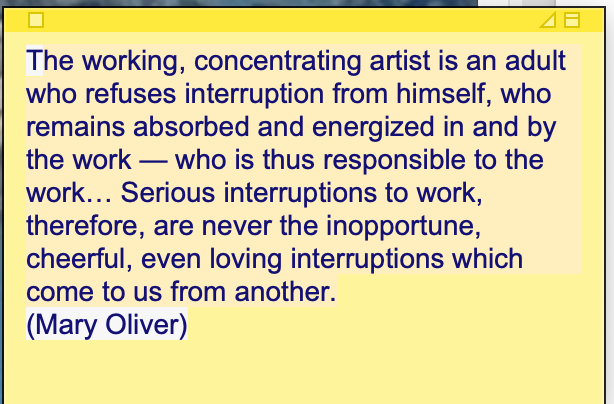
The fact that this note, despite its bright yellowness, had disappeared into some crevice among my files, suggests that I had long given up on its message. Retirement has significantly reduced the external (“inopportune, cheerful, even loving”) interruptions from others, yet it has created a space in the restless mind for more internal interruptions. That sense, honed and heightened, of being needed and on call, remains in a state of waiting, refusing to yield to the possibility—the reality—of having time of one’s own.
How then, does one move into the benign ruthlessness needed to create without expectation or demand, to answer the call that one has refused to heed for years, from tentative ideas nudging deeper thought? How can I control the state of internal distraction, of the monkey-mind that is so ready to shift attention to random tasks of the moment, to the “shoulds” and “must-dos”?
Daphne, a schoolteacher and the central character in Ann Patchett’s 2026 novel Whistler, ruminates on what it feels like each year when the vacation begins:
There was always a period of adjustment after school let out, a sudden realization that once again my time was my own. Every year the ghost memory of obligations followed me well into June (I have to grade papers! I have to look at Persuasion before class!) until finally I shook them off, though the dreams in which I was late, unprepared or in the wrong room speaking the wrong language never left me. It was strange to have so much to think about and so little to do.
I do have much to think about, and little to do in the way of obligations, but as it all too often happens with women, domestic obligations (real, imposed, and imagined) sneakily slide into the space taken up previously by workplace demands. The time and energy that one had spent on work, however “consequential” that work may have been, may have been regarded as time away from the real purpose of one’s life—domestic care work. This becomes the “ghost memory” of obligations that one has carried through life and now cannot be set aside, because, all said and done, you have, with retirement, transcended work demands. For academics, of course, engagement with work-life can continue far beyond retirement, and it does for me, too. But I cannot deny that there are large swathes of time becoming available to me, to pursue the ideas and the writing that I have always wanted to do...or perhaps, claimed (or believed) I wanted to do.
So why is it that it has been so difficult to find a rhythm to this phase of my life?
To make it somewhat clearer (and also more pathetic, maybe?), here’s a description of my last two days (if this seems a bit like TMI to some of you, please skip the next paragraph):
I’m in my daughter’s home for a visit for no purpose other than to spend time with her and catch up with friends in the region. It’s my first trip to this part of the world (or anywhere, really), in many, many years, without a work agenda. To do this, I had to convince myself that it was okay to leave the usual running of the home and care responsibilities to my partner and my remarkably able 85-year-old mother—which, for me, is no easy task. So, I get here and the weekend passes, legitimately relaxed owing to jetlag and catching up. Monday is the first day I am entirely on my own, no routine to be subsumed by, no demands on my time. I can actually begin using the time to write, even though I do have some reviewing to do and talks to prepare for; nothing major, easily handled spaced out over a few days. My time is otherwise my own. Unused to such a luxury, I am restless. So, I spend three hours reorganizing my daughter’s kitchen cupboards, doing laundry, walking down to the grocery store. I’m pleased to hear she’s bringing a colleague home for dinner so I set to cooking. Anything to keep me away from the keyboard and blank page. Day 2 is more of the same, except this time I am reorganizing the linen cupboard and doing more laundry. I have succeeded in distracting myself completely from the act of writing.
Now, I can put it off no longer. There are no more tasks urgently calling to me. I must finish this (perhaps inconsequential) piece of writing that I have undertaken, a sort of exploration of this state of un-writerly being. A friend and I have talked about finding a writing rhythm that we can stick to no matter what, trying things like “morning pages” (recommended by Julia Cameron in her book The Artist’s Way). My arthritic fingers give up some twenty lines in, and in a few days the possibility of habit escapes me.
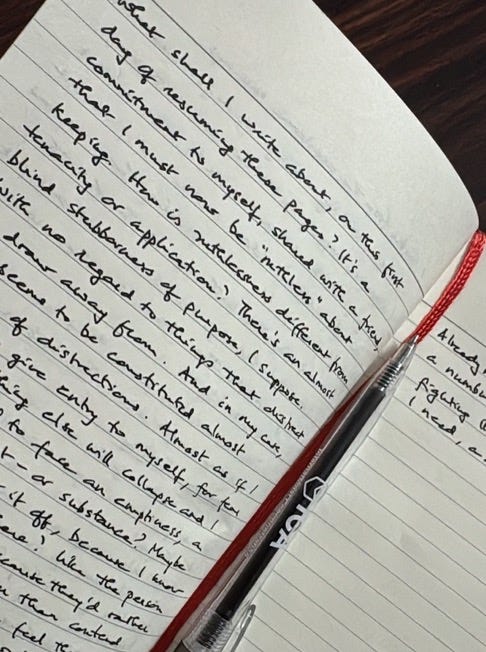
I am resolved to now be ruthless about finding this rhythm, about getting to a place where my fingers can fly and words are more than pre-woven strings of letters falling into habituated meaning (how else do we prove we are not stochastic parrots?). Maybe I can’t do morning pages, but I can find hours in the day when I refuse distraction from myself, can’t I? If I could find a way to end this rambling note, maybe there is hope for me yet.
...
Podcasts about writing process, finding one’s way into writing can offer inspiration— although, as The Podcast Review put it, “Listening to the podcasts on this list won’t substitute sitting down and putting words on paper.” Here are just a couple from the many out there.
· For more on the “morning pages”, here is Julia Cameron speaking to Fearne Cotton:
· One of my favourites, gentle conversations with writers, hosted by Mitzi Ripkin: https://firstdraftwriters.com
· Not so much about writing, more about what writing does/can do in our troubled world: https://linnullmann.no/en/project/how-to-proceed-2/
And of course, there is the now discontinued Longform podcast, which is still worth looking at for some insightful conversations around craft.
I tried the morning pages years ago and eventually gave up. Give yourself time to adjust—after decades of activity, it takes time to adjust to having time for yourself. Don't push yourself, just let your mind get used to the space, and things will settle. Maybe try going for walks instead of rearranging Achala's cupboards? If it's not too hot.
Lovely. But (as you say, and not that I’m doing it), be ruthless with protecting your writing time.